| HS Code | 522133 |
| Density | 0.918 g/cm³ |
| Melt Flow Index | 2.0 g/10 min (190°C, 2.16 kg) |
| Melting Point | 122°C |
| Vicat Softening Point | 105°C |
| Tensile Strength At Yield | 12 MPa |
| Tensile Strength At Break | 18 MPa |
| Elongation At Break | 800% |
| Flexural Modulus | 320 MPa |
| Shore D Hardness | 55 |
| Dart Drop Impact | 120 g (F50) |
| Film Haze | 12% |
| Film Gloss 45 Deg | 45 units |
As an accredited Linear Low‑Density Polyethylene DFDA‑7042H factory, we enforce strict quality protocols—every batch undergoes rigorous testing to ensure consistent efficacy and safety standards.
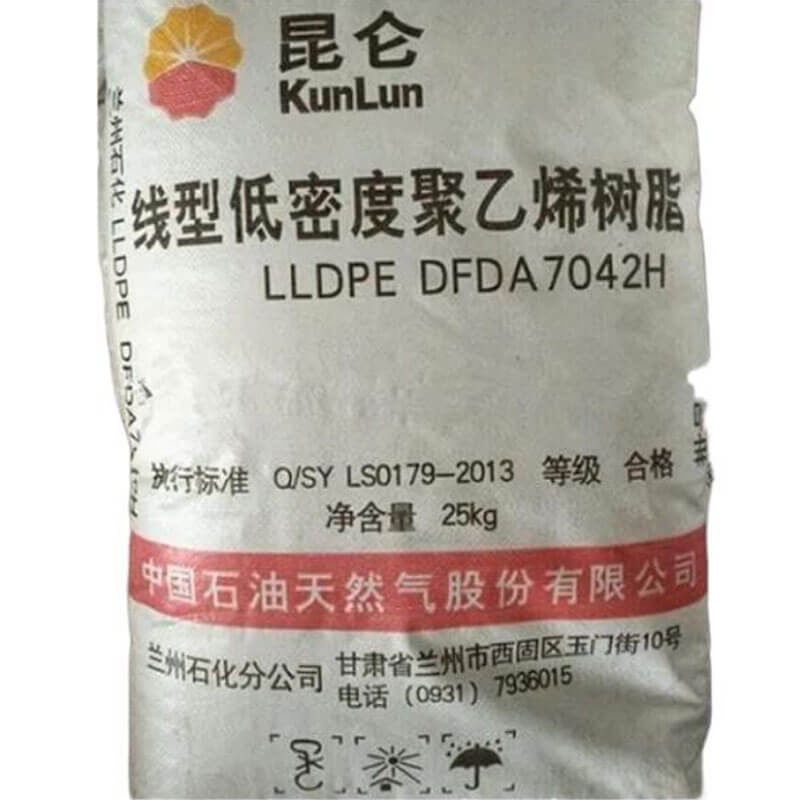
| Packing | Linear Low-Density Polyethylene DFDA-7042H is packaged in 25 kg moisture-proof bags, palletized and shrink-wrapped for safe transport. |
| Container Loading (20′ FCL) | 20′ FCL container loading of LLDPE DFDA-7042H: palletized PP woven bags, properly secured, ventilated, protected from moisture and contamination. |
| Shipping | Linear Low-Density Polyethylene DFDA-7042H is shipped as free-flowing pellets in valve-type woven bags, bulk bags, or railcars/trucks. Keep dry, avoid heat and direct sunlight. Load in clean containers, secure properly, and protect from contamination. No special hazard classification; handle with standard industrial hygiene practices. |
| Storage | Store Linear Low-Density Polyethylene DFDA‑7042H in a cool, dry, well-ventilated area, away from direct sunlight, heat sources, and open flames. Keep packaging sealed to prevent moisture contamination and dust accumulation. Avoid storing near strong oxidizers. Maintain temperatures below 50°C. Handle with care to minimize fines and static discharge. |
| Shelf Life | Shelf life is indefinite if stored in a dry, cool, well-ventilated area, away from direct sunlight and heat sources. |
Across heavy-duty industrial liner production, DFDA-7042H—nominal density 0.918–0.922 g/cm³, melt flow rate 1.8–2.2 g/10 min at 190°C under 2.16 kg load per ISO 1133-1:2022—is introduced as the primary structural resin at 70–90 wt% of the dry blend, with a low-density polyethylene film grade such as LDPE 2426H at 10–25 wt% to stabilise the bubble and a polyolefin antiblock/slip masterbatch at 2–5 wt%. The converter runs this formulation on single-screw extruders with L/D 25:1–30:1 and barrier screws, using barrel temperature profiles of 160°C, 180°C, 195°C, 200°C, and 205°C from feed to die, a die head at 190–210°C, and a dual-lip air ring with internal bubble cooling. Die gap is held at 1.8–2.5 mm because LLDPE’s higher apparent shear viscosity produces sharkskin melt fracture when the gap narrows below 1.5 mm; blow-up ratio is maintained at 2.5:1–3.5:1, and frost line height is set at 4–8 die diameters to balance machine-direction and transverse-direction tear resistance. Compliance verification for industrial liners relies on ASTM D1709 dart impact, ASTM D1922 Elmendorf tear, ISO 527-3 tensile properties, and ASTM D882 film tensile, while REACH and RoHS apply to export shipments into the EU and EEA. The principal production risk is low-frequency bubble oscillation when frost line height is set too low, generating gel clusters and a measurable drop in dart impact; this is corrected by widening die gap or reducing line speed rather than raising melt temperature above 210°C. Terminal products include 50–150 µm industrial liners, construction demolition sacks, and flat-bottom agricultural storage bags, where the LLDPE component supplies puncture resistance and weld strength in continuous bag-conversion machinery.
| Parameter | Thin-gauge 10–50 µm | Heavy-gauge 100–200 µm |
|---|---|---|
| Die gap | 1.6–2.0 mm | 2.0–2.5 mm |
| Blow-up ratio | 2.0:1–2.7:1 | 2.5:1–3.5:1 |
| Frost line height | 3–6 die diameters | 4–8 die diameters |
| Melt temperature | 170–205°C | 190–210°C |
| Line output per die circumference | 0.8–1.5 kg/h/mm | 1.2–2.0 kg/h/mm |
Food-contact packaging conversion using DFDA-7042H is governed not by processing temperature but by additive migration limits under FDA 21 CFR 177.1520(c), EU Regulation (EU) No 10/2011, and Chinese GB 4806.7-2016, with additive masterbatches that must also comply with GB 9685-2016 where used in PRC-produced export packaging. The standard dry blend for monolayer food-contact film comprises 75–85 wt% DFDA-7042H, 10–20 wt% LDPE autoclave-film grade for optical clarity and heat-seal strength, and 2–5 wt% food-contact-approved slip/antiblock concentrate. The target coefficient of friction is 0.20–0.40 measured by ASTM D1894, which permits form-fill-seal webs to pass over horizontal and vertical formers without chatter while avoiding excessive slip-agent migration into packed dry foods. Converters run the blend at 170–205°C melt temperature, with die gap 1.6–2.0 mm, blow-up ratio 2.0:1–2.7:1, and frost line height 3–6 die diameters; corona treatment is applied in-line to 38–42 mN/m for downstream printing and lamination. When coextruded, a food-contact skin containing DFDA-7042H at 20–25 µm thickness is paired with a recycled or coloured core and a reverse-printable outer layer. The main operational boundary is storage temperature: exposure above 60°C accelerates erucamide bloom, and contact with high-surface-area dry foods may require total migration testing per EU Regulation (EU) No 10/2011 with simulant D1 or D2 depending on fat content. Terminal products include frozen vegetable bags, bakery overwrap, dry food pouches, and pillow-pack FFS webs.
Wide-die agricultural film processing with die diameters above 400 mm places DFDA-7042H in a shear-thinning regime where melt fracture appears as sharkskin on the bubble surface when shear stress at the die lip exceeds the critical value for this resin. The formulation for silage and greenhouse films therefore combines 80–95 wt% DFDA-7042H with 5–20 wt% metallocene LLDPE to improve dart impact and extensional uniformity, while 2–4 wt% of a UV stabiliser masterbatch containing HALS or benzophenone chemistry is metered gravimetrically; anti-drip greenhouse covers add 0.5–1.5 wt% of a non-ionic surfactant concentrate, and silage films may add near-infrared blocker masterbatch at 1–3 wt% where light transmission control outweighs oxygen barrier. The blown-film line is operated with a 2.0–2.5 mm die gap, blow-up ratio 2.0:1–3.5:1, internal bubble cooling, and dual-lip air ring; frost line height is held at 4–8 die diameters and melt temperature is controlled within ±5°C around 195–205°C to prevent bubble-stalk oscillation. Compliance for agricultural plastics draws on EN 13206:2017 for covering thermoplastic films, ASTM D3985 for oxygen transmission rate, ASTM F1249 for water vapour transmission rate, and ISO 527-3 for tensile characterisation; silage film additionally requires retention of mechanical properties after UV ageing under the annex methods of EN 13206:2017. Terminal products include 150–200 µm silage bags and bunker covers, 80–150 µm greenhouse covers, and 10–25 µm high-drawing mulch films. The principal failure mode observed on production lines is frost line breathing that creates gauge bands and weak transverse tear; this is suppressed by reducing air-ring pressure and raising internal bubble cooling exhaust temperature rather than increasing melt temperature above 210°C.
| Scenario | Standard or regulation | Function |
|---|---|---|
| Heavy-duty liners | ASTM D1709, ASTM D1922, ISO 527-3 | Dart impact, tear propagation, tensile |
| Food-contact packaging | FDA 21 CFR 177.1520(c), EU Regulation (EU) No 10/2011, GB 4806.7-2016 | Food-contact authorisation and migration |
| Agricultural films | EN 13206:2017, ASTM D3985, ASTM F1249 | Covering film durability, oxygen and moisture transmission |
| Masterbatch carrier resin | REACH, RoHS, FDA 21 CFR 177.1520(c) where applicable | Substance registration and food-contact additive compliance |
| Cast stretch film | ISO 527-3, ASTM D882, ASTM D1894 | Tensile, elongation, coefficient of friction |
| Cold-chain packaging | ASTM D1709, ISO 527-3, FDA 21 CFR 177.1520(c) where food-contact | Low-temperature impact, tensile, food-contact compliance |
When twin-screw compounding polyolefin masterbatch requires a carrier with melt-flow alignment to film-grade converters, DFDA-7042H functions as the polymer carrier at 30–70 wt% of the concentrate formula; active pigments or additives occupy 10–60 wt%, and mineral fillers such as calcium carbonate or talc occupy 10–50 wt% depending on the target let-down ratio and the dispersion sensitivity of the downstream film. Compounding is performed on co-rotating twin-screw extruders with L/D 40:1–52:1, segmented screw elements, side feeding of fillers at zone 5, vacuum venting at -0.06 to -0.09 MPa, and underwater pelletising with die plate temperatures 200–220°C. Barrel temperature zones are held at 180–220°C, and screw speed is set between 300 rpm and 600 rpm to generate sufficient shear for pigment dispersion without reducing the carrier’s molecular weight. Melt filtration through 80–120 mesh screens protects downstream blown-film die lines from agglomerates. The carrier is selected because its melt flow rate of 1.8–2.2 g/10 min keeps viscosity close to film-grade polyethylene, reducing melt-pressure gaps when the masterbatch is let down at 2–5 wt% in blown-film production. Compliance for masterbatch intended for food-contact use requires the final additive package to meet FDA 21 CFR 177.1520(c) and EU Regulation (EU) No 10/2011, while general industrial concentrates fall under REACH and RoHS; colourants must be selected against GB 9685-2016 where applicable. The processing boundary appears when filler loading exceeds 60 wt%; at that point the carrier’s comparatively low melt flow index cannot sufficiently wet filler surfaces, and the compound may require 5–10 wt% of a low-molecular-weight polyethylene wax or a higher-flow carrier component to avoid screw blockages. Terminal product types include colour concentrates, slip/antiblock masterbatches, UV stabiliser concentrates, and filler masterbatches used in blown film, cast film, and injection moulding.
In cast stretch film conversion, DFDA-7042H is blended as a stiffness and puncture modifier rather than as the sole resin; the formulation is typically 60–80 wt% DFDA-7042H, 20–40 wt% metallocene LLDPE with higher clarity and cling, and 1–3 wt% polyisobutylene or similar cling agent added via liquid dosing or masterbatch. The cast film line uses a single-screw extruder of 90–150 mm diameter with a barrier screw, a T-die of 1,500–3,000 mm width, and a chill roll held at 15–25°C; vacuum box and air knife positioning are adjusted so that the melt curtain contacts the chill roll within 20–40 mm of the die lip to reduce neck-in and thickness variation. Line speed is set at 300–600 m/min, and edge trim is recycled in-line at 5–10 wt% without intermediate pelletising, provided the trim stream is kept below 80°C during conveying. Compliance for stretch film focuses on ISO 527-3 tensile elongation, ASTM D882 tensile modulus, and ASTM D1894 coefficient of friction; food-contact stretch films additionally require FDA 21 CFR 177.1520(c) or EU Regulation (EU) No 10/2011 compliance when direct contact with primary food packaging is claimed. The main limitation is gauge reduction: the melt flow rate of DFDA-7042H at 1.8–2.2 g/10 min restricts stable drawdown below 15 µm on high-speed lines; converters targeting 8–12 µm films usually replace a portion with a higher-flow mLLDPE to avoid melt curtain resonance. Terminal products include machine pallet wrap, hand stretch wrap, and agricultural bale wrap, where the DFDA-7042H fraction raises puncture propagation resistance during sharp-edge pallet loads.
Cold-chain packaging that must resist brittle failure at -30°C relies on a blend of 80–90 wt% DFDA-7042H and 10–20 wt% hexene- or octene-based metallocene LLDPE to retain low-temperature impact strength while preserving the film-grade melt flow of the base resin. The structure is produced as a three-layer coextruded blown film with die gap 2.0–2.5 mm, blow-up ratio 2.5:1–3.0:1, and melt temperature 190–210°C; internal bubble cooling is used to shorten the frost line and reduce excessive orientation that would otherwise embrittle the film at sub-zero temperatures. Compliance testing for this segment uses ASTM D1709 dart impact and ISO 527-3 tensile properties after conditioning at -20°C or -30°C, and food-contact packaging variants are assessed under FDA 21 CFR 177.1520(c) where frozen foods are packed directly in the film. The formulation addition ratio must be controlled within ±5 wt% of the mLLDPE target because higher mLLDPE levels above 20 wt% raise melt pressure and can force extruder amps beyond the motor limit on older 75 mm lines; lower levels below 10 wt% produce a measurable drop in dart impact at -20°C. Terminal product types include frozen food bags, ice salt and ice melt packaging, cold-chain dunnage bags, and liner films for insulated shipping containers. A production-scale failure observed at the transition from ambient to cold-chain grades is brittle folding at crease points in gusseted bags; this is rectified by increasing blow-up ratio or replacing a portion of the mLLDPE with a higher-molecular-weight LLDPE rather than by raising processing temperature.
Competitive Linear Low‑Density Polyethylene DFDA‑7042H prices that fit your budget—flexible terms and customized quotes for every order.
For samples, pricing, or more information, please contact us at +8618136850665 or mail to sales4@ascent-chem.com.
We will respond to you as soon as possible.
Tel: +8618136850665
Email: sales4@ascent-chem.com
Flexible payment, competitive price, premium service - Inquire now!
Linear low‑density polyethylene DFDA‑7042H is a film‑extrusion resin produced by low‑pressure copolymerisation of ethylene with a short‑chain α‑olefin. The H suffix denotes a licensor‑specific comonomer or additive configuration, and the comonomer identity is recorded on the batch certificate of analysis. The material is supplied as white free‑flowing granules, typically with a nominal melt mass‑flow rate of 2.0 g/10 min determined at 190 °C under a 2.16 kg load according to ISO 1133-1:2022, and a nominal density of 0.918 g/cm³ determined at 23 °C according to ISO 1183-1. These values place the resin in the medium‑melt‑index blown film class where torque demand on grooved‑barrel extruders is moderate and drawdown behaviour is suitable for film thicknesses from 15 µm to 150 µm. The resin is not designed for rotational moulding or high‑shear injection moulding; its molecular weight distribution and stabiliser package are optimised for tubular film cooling.
Unlike autoclave or tubular low‑density polyethylene, the resin has no long‑chain branching, and the resulting linear architecture changes both melt rheology and solid‑state performance. Short‑chain branch type and distribution affect toughness: butene comonomer introduces ethyl branches, while hexene comonomer introduces butyl branches and generally increases tie‑chain density at the same density. If the H suffix designates hexene copolymerisation, the resin should show higher dart impact and Elmendorf tear than a butene‑based LLDPE of identical melt index and density. Because standard certificates of analysis rarely include temperature rising elution fractionation or short‑chain branching distribution, converters requiring guaranteed toughness should request comonomer identity and branching data from the producer.
Bubble stability is governed by melt strength rather than by pellet feed uniformity. On single‑screw extruders with longitudinal grooved barrels and barrier screws of 25:1 to 30:1 L/D, melt temperatures between 190 °C and 220 °C sustain a stable bubble when the annular die gap is maintained between 0.8 mm and 2.2 mm. At melt temperatures above 235 °C, oxidative degradation can introduce gel particles and odour; below 175 °C, torque increases and die‑lip deposits accumulate. Blow‑up ratios above 3.0:1 without LDPE modification frequently induce bubble breathing because the linear chains lack long‑chain branching; below 1.8:1, transverse tear resistance is reduced. Frost‑line height is normally held at 2 to 4 die diameters to balance haze and blocking. Internal bubble cooling systems permit the upper bound to be extended by 0.5 die diameters when gauge variation must remain below ±5% at 120 µm.
At 50 µm thickness, the film shows the expected machine‑direction/transverse‑direction anisotropy. Tensile yield stress under ISO 527-3 is generally 10 to 13 MPa in the machine direction and 9 to 12 MPa in the transverse direction; elongation at break under the same standard is 500% to 650%. Dart impact resistance under ISO 7765-1 Type A falls between 75 g and 110 g for 50 µm film, while haze by ASTM D1003 is 8% to 14%. These values support agricultural mulching film, industrial liners, garment bags, and laminated outer webs, but high‑clarity freezer packaging requires a metallocene grade with lower haze and higher gloss.
Low‑shear melt viscosity measured by rotational rheometry in the terminal region is lower than that of LDPE, which explains the bubble‑stability limitation. Reported values for similar LLDPE film grades at 0.1 rad/s and 190 °C fall between 0.8 × 10⁴ Pa·s and 1.5 × 10⁴ Pa·s, while tubular LDPE frequently lies between 1.5 × 10⁴ Pa·s and 3.0 × 10⁴ Pa·s. The lower zero‑shear viscosity reduces air‑ring stability but permits higher draw ratios and thinner gauge. At high shear rates, the die‑land wall shear stress controls sharkskin onset; for LLDPE of this class, sharkskin typically appears at wall shear stresses above 0.14 MPa to 0.20 MPa at 190 °C on clean chromium‑plated dies. Widening the die gap or adding a fluoropolymer processing aid shifts the onset to higher throughput.
Blending 10% to 30% by weight of autoclave or tubular LDPE raises low‑shear viscosity and increases bubble stability on air‑ring‑cooled lines, but it lowers dart impact at equal thickness. When the LDPE content exceeds 30%, haze increases and the modulus of the film rises; when it is below 10%, the effect on bubble stability is insufficient to compensate for die‑lip burring on worn dies. Substitution of mLLDPE into DFDA‑7042H is limited by melt‑pressure rise. At mLLDPE fractions above 50%, screw temperature rise may push melt temperature above 225 °C because of high shear viscosity. A blend of 70% DFDA‑7042H and 30% LDPE is often run on conventional lines for 60 µm film with a dart impact near 90 g under ISO 7765-1, but converter validation and lot‑to‑lot gel counts are required.
Relative to high‑density polyethylene film resins with density from 0.945 g/cm³ to 0.960 g/cm³, DFDA‑7042H has lower crystallinity and secant modulus, higher Elmendorf tear and dart impact, and a higher water vapour transmission rate under ISO 15106-2. Against metallocene LLDPE of the same melt index, DFDA‑7042H tends to have a broader molecular weight distribution, giving higher melt strength and extruder output but higher haze and lower dart impact. The grade is therefore selected when processability on existing blowing lines and toughness at low gauge are more important than optical clarity or hot‑tack performance under ASTM F1921.
Common processing defects observed on production lines include unstable bubble breathing at high blow‑up ratio, sharkskin on inner film surfaces, and die‑lip buildup. Bubble breathing is reduced by adding 5% LDPE or by lowering frost‑line height; sharkskin is addressed by increasing die gap to 2.2 mm or adding 200 mg/kg to 500 mg/kg of a fluoropolymer processing aid. Die‑lip buildup is controlled by maintaining die‑lip temperature 10 °C above the adapter temperature and by cleaning the die lips every 48 h of continuous operation. When gauge variation exceeds ±5% at 100 µm, the root cause is usually uneven air‑ring airflow or a worn die pin rather than resin variation.
In cast‑film extrusion, DFDA‑7042H is less common but can be run with chill‑roll temperatures of 20 °C to 30 °C and air‑knife pinning. Compared with LDPE, the linear structure produces higher neck‑in and edge bead; die lip gaps of 0.5 mm to 0.8 mm and air‑knife pressure below 0.15 MPa reduce edge waste. Published data for this specific configuration is limited, and cast‑film trials should be conducted before specifying the resin for stretch or lamination applications.
Direct substitution for LDPE on a legacy air‑cooled line requires profile adjustments rather than a simple resin swap. The extruder barrel zones in the feeding and compression sections are lowered by 5 °C to 10 °C, and the die gap is widened to 1.5 mm to 2.0 mm to avoid melt fracture. Motor load may increase by 10% to 20% if L/D is below 25:1. When the line previously ran mLLDPE, DFDA‑7042H permits higher screw speed before reaching pressure limits, but heat‑seal initiation temperature rises by 5 °C to 10 °C under ASTM F1921, and haze increases. These differences require re‑qualification of seal jaws and optical inspection thresholds.
In three‑layer coextruded structures, DFDA‑7042H is used as a skin layer to provide low seal initiation temperature and high dart impact while the core layer imparts stiffness. A typical A/B/A film with an HDPE core is processed on a three‑layer die with die gap settings of 1.4 mm for the skins and 1.0 mm for the core; the skin layer melt temperature is held at 205 °C to 215 °C. In five‑layer structures containing an EVOH barrier, LLDPE skins are combined with tie resins to prevent delamination under flex‑crack testing. The absence of long‑chain branching in DFDA‑7042H reduces interfacial instability when the skin and core layer viscosity ratios are kept below 2:1.
Throughput on a 75 mm grooved‑barrel extruder with 30:1 L/D and a 250 mm die typically reaches 180 kg/h to 240 kg/h when melt temperature is 210 °C and backpressure is 25 MPa to 35 MPa. Specific energy consumption is approximately 0.25 kWh/kg to 0.35 kWh/kg, depending on screw speed and die restriction. At screw speeds above 120 rpm, the resin may show melt‑flow instability if the die gap is below 1.2 mm. Published data for this specific configuration is limited; the values are indicative of this film resin class and should be verified on the target extruder.
For food‑contact packaging in the United States, DFDA‑7042H is assessed under FDA 21 CFR 177.1520 olefin polymers when the finished package meets applicable extraction limits. In the European Union, Commission Regulation (EU) No 10/2011 requires overall migration and specific migration testing in the final packaging rather than on the resin alone. Under Directive 2011/65/EU Annex II, typical total cadmium is below 100 mg/kg and lead below 1000 mg/kg, but supplier verification is necessary. REACH obligations under Regulation (EC) No 1907/2006 are met only if the latest SVHC list and registration dossier are confirmed with the producer.
Pellets should be stored away from direct sunlight at temperatures below 40 °C. Drying is not necessary unless surface condensation from outdoor storage has occurred; in that case, a hopper dryer at 60 °C for 30 min removes surface moisture. Recycled edge trim from DFDA‑7042H film can be re‑introduced at up to 20% by weight if gel counts on an optical film scanner remain within product control limits. Tin‑based or copper‑based heat stabilisers in reprocessed post‑industrial streams should be avoided because transition metal residues can accelerate thermo‑oxidative degradation.
In agricultural tunnel and silage films, DFDA‑7042H is commonly blended with 5% to 8% of a UV stabiliser masterbatch based on hindered amine light stabilisers and benzotriazole ultraviolet absorbers. The linear resin contributes to tear propagation resistance measured by ISO 6383-2; typical machine‑direction tear strength for a 120 µm film falls between 6 N/mm and 10 N/mm, but published data for this specific formulation is limited. Gauge uniformity must be maintained through internal bubble cooling and oscillating haul‑off to prevent thin spots that become preferential UV degradation sites.