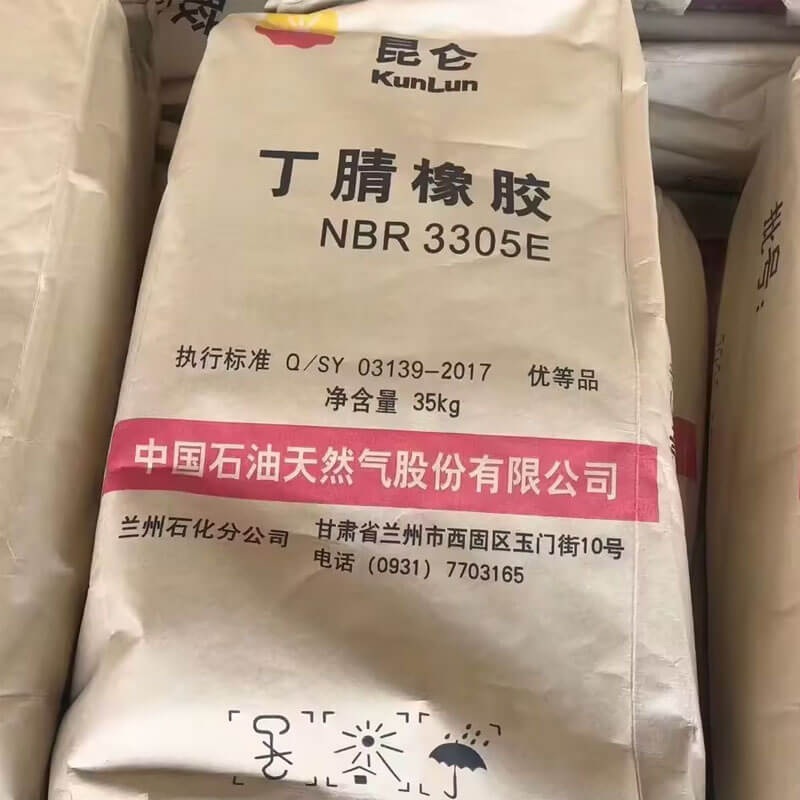
| HS Code | 833165 |
| Chemical Name | Acrylonitrile-Butadiene Rubber |
| Cas Number | 9003-18-3 |
| Color | Light yellow |
| Physical Form | Solid bales or slabs |
| Acrylonitrile Content | 33.5% nominal (range 33-35%) |
| Mooney Viscosity Ml 1 4 100 C | 45 MU (typical range 40-50) |
| Density | 0.98 g/cm³ |
| Ash Content | ≤0.5% |
| Volatile Matter | ≤0.75% |
| Stabilizer Antioxidant | Non-staining phenolic antioxidant |
| Solubility | Soluble in ketones and aromatic hydrocarbons; insoluble in water and aliphatic alcohols |
| Glass Transition Temperature | Approximately -30°C |
As an accredited Acrylonitrile‑Butadiene Rubber 3305E factory, we enforce strict quality protocols—every batch undergoes rigorous testing to ensure consistent efficacy and safety standards.
| Packing | Acrylonitrile-Butadiene Rubber 3305E is supplied in 25 kg bales, individually wrapped in polyethylene film, then palletized and shrink-wrapped. |
| Container Loading (20′ FCL) | 20′ FCL: Acrylonitrile-Butadiene Rubber 3305E loaded on pallets, wrapped, secured, container sealed for safe transport. |
| Shipping | Acrylonitrile-Butadiene Rubber 3305E ships as a non-hazardous material in sealed, polyethylene-lined bags or bales to prevent moisture uptake and contamination. It is suitable for truck, rail, or ocean container transport. Avoid direct sunlight and heat; store in a cool, dry, ventilated area. No special UN classification required. |
| Storage | Store Acrylonitrile‑Butadiene Rubber 3305E in a cool, dry, well‑ventilated area away from direct sunlight, heat sources, and open flames. Keep containers tightly sealed to prevent moisture absorption and contamination. Avoid contact with strong oxidizers. Maintain moderate temperatures to preserve polymer properties. Use proper handling and storage practices to prevent degradation and ensure material stability during its shelf life. |
| Shelf Life | Typical shelf life is 2–3 years when stored in a cool, dry place, away from direct sunlight and sources of heat. |
Across under-hood sealing lines, compression-set failures in NBR 3305E are traced less to base polymer deficiency than to under-developed crosslink density when injection-moulding cycles are shortened below the sulphur donor plateau. The grade’s 33 ± 1 wt% acrylonitrile level provides a practical balance between ASTM Reference Oil No. 1 and IRM 903 volume swell resistance, while its Mooney ML 1+4 (100 °C) of 45 ± 5 permits flow paths down to 0.35 mm without excessive packing pressure. Compliance for under-hood sealing is written against ASTM D2000-12 Type M, Class BG, supplemented by SAE J200 and ISO 3601-1:2012 for O-ring cross-section tolerances. A production starting recipe is 100 phr NBR 3305E, 5 phr zinc oxide, 1 phr stearic acid, 1.5 phr sulphur, 1.7 phr N-cyclohexyl-2-benzothiazolesulfenamide, 0.3 phr tetramethylthiuram disulphide, 70 phr carbon black N550, 10 phr dioctyl adipate, and 2 phr polymerised 2,2,4-trimethyl-1,2-dihydroquinoline. Two-stage mixing is run in an intermeshing internal mixer with 0.8 fill factor at 40 rpm; the first stage drops at 145 °C, and the curatives are added on a 55 °C open mill after a 24 h rest to minimise scorch. Injection moulding of gasket cross-sections 1.5–3.0 mm uses a 270-ton press, barrel 75 °C, tool 175 °C, and cure 240 s, followed by 4 h post-cure at 150 °C. Terminal parts produced under this specification include valve-cover gaskets, intake-manifold flange seals, water-pump housing seals, and coolant-plate seals for hybrid-electric battery thermal management.
| Standard | Clause / Test Method | Acceptance Criterion |
|---|---|---|
| ASTM D2000-12 | Type M, Class BG | Under-hood oil and heat service |
| ASTM D412-16 | Die C | 14 MPa min tensile, 250% min elongation |
| ASTM D395-18 | Method B, 125 °C, 70 h | 22% max compression set |
| ISO 3601-1:2012 | Dimension and surface acceptance | Parting-line protrusion below 0.05 mm |
The inner-liner compound for low-emission fuel hose is formulated around the 33 wt% acrylonitrile level of NBR 3305E because lower ACN grades permit excessive aromatic swell, while higher ACN grades raise low-temperature stiffening beyond the SAE J30 flexibility limits. Published fuel permeation coefficients for this specific compound in SAE J30 constructions are limited; the following starting formulation reflects standard 33 wt% NBR practice. The recipe is 100 phr NBR 3305E, 65 phr N660 carbon black, 15 phr treated fumed silica, 12 phr trioctyl trimellitate, 5 phr zinc oxide, 1 phr stearic acid, 1.2 phr sulphur, 1.5 phr N-tert-butyl-2-benzothiazolesulfenamide, and 0.2 phr tetramethylthiuram disulphide. The addition of fumed silica above 15 phr reduces petrol swell but raises compound Mooney to a point that destabilises the inner-liner wall thickness on multi-layer coextrusion; below 10 phr, the uncured tube sags before the salt-bath entry. Coextrusion is performed on 60 mm/45 mm/45 mm pin-barrel cold-feed extruders with 24:1 L/D, inner layer thickness 0.5–1.0 mm, followed by aramid or polyester braid and an outer CSM or ECO cover. Continuous vulcanisation in a salt-bath line at 205 °C for 90 s is followed by 2 h post-cure at 120 °C. Compliance is assessed under SAE J30, ISO 19013-1:2005, and evaporative emission limits under CARB TP-501 for permeation components. Terminal products include low-pressure fuel return lines, carburettor feed hoses, marine petrol supply hoses, and small-engine fuel lines. NBR 3305E is not specified for methanol-blended fuels above 10 vol% or continuous aromatic fluid temperatures above 60 °C.
Because thick-section oilfield packer elements develop visible cure gradients when a fast-accelerated gasket recipe is transferred directly to compression moulding, NBR 3305E is recompounded with a slower sulfenamide-to-thiuram ratio and a semi-reinforcing thermal black. The resulting compound is aimed at 80 ± 5 Shore A hardness and must remain compliant with API 11D1 packer sealing element qualification, ISO 23936-2:2011 for elastomeric materials in petroleum and natural gas service, and NACE TM0187-2011 for sour-fluid coupon screening. A typical formulation is 100 phr NBR 3305E, 45 phr N330 carbon black, 10 phr N990 thermal black, 5 phr zinc oxide, 1 phr stearic acid, 1.0 phr sulphur, 2.0 phr N-cyclohexyl-2-benzothiazolesulfenamide, 1.0 phr tetramethylthiuram disulphide, 5 phr polymerised 2,2,4-trimethyl-1,2-dihydroquinoline, and 5 phr trioctyl trimellitate. The mixed stock is pre-formed into cylindrical segments and compression moulded in 500-ton presses with tool temperature 160 °C for 45 min per 25 mm section, then step-post-cured 4 h at 150 °C under nitrogen to reduce oxidative embrittlement. Mould filling is deliberately kept below 80% of cavity volume at the first preform stage to avoid trapped air at the metal insert interface. Terminal products include compression-set packer elements, annular blowout preventer sealing elements, and BOP choke seals. Sour gas exposure with H₂S partial pressure above 0.05 MPa is outside the recommended operation envelope for NBR 3305E; NACE TM0187 coupon screening should precede any high-sour qualification.
In marine hydraulic cylinder service, seal compounds based on NBR 3305E are evaluated where zinc-free ISO VG 46 hydraulic fluids and continuous bulk oil temperatures of 80–90 °C require hydrolysis-resistant plasticiser retention. The formulation is 100 phr NBR 3305E, 50 phr N774 carbon black, 20 phr N550 carbon black, 8 phr trioctyl trimellitate, 5 phr zinc oxide, 1 phr stearic acid, 1.2 phr sulphur, 2.2 phr dibenzothiazyl disulphide, and 0.8 phr diphenylguanidine. The process route is compression moulding in 150-ton presses with 170 °C tools for 8 min on small-batch seals of 25–80 mm outer diameter, followed by 2 h post-cure at 140 °C. Compliance targets include ISO 6072:2011 for hydraulic fluid compatibility, ISO 3601-3 for surface acceptance, and ISO 188:2011 for accelerated ageing in air. The terminal components are marine steering-gear rod seals, rudder-stock seals, and stabiliser shaft wipers. Published data for NBR 3305E specifically in zinc-free marine hydraulic fluids are limited; batch qualification must include 70 h immersion at 100 °C in the actual hydraulic oil because additive packages vary widely.
Where lubricant immersion and wet-end mill conditions preclude urethane roll covers, NBR 3305E is calendered onto a primed steel core for oil-resistant industrial rolls; the process is governed by adhesive bonding under delayed-cure autoclave vulcanization. The compound is 100 phr NBR 3305E, 55 phr N550 carbon black, 25 phr precipitated silica, 15 phr dioctyl adipate, 5 phr zinc oxide, 1 phr stearic acid, 1.2 phr sulphur, 2.0 phr N-cyclohexyl-2-benzothiazolesulfenamide, and 0.3 phr tetramethylthiuram disulphide. The steel core is grit-blasted to Sa 2.5 under ISO 8501-1, primed with a heat-cured rubber-metal adhesive, and wrapped with calendered sheet 6–12 mm on a three-roll building machine. Autoclave cure is run at 142 °C for 6 h under 0.6 MPa steam, followed by finish grinding with 40–60 grit to tolerances under ISO 6123-1:2015. Terminal parts include steel-mill wringer rolls, paper-machine guide rolls, textile winch rolls, and cold-rolling oil skid rolls.
The upper mill roll temperature during high-styrene resin blending is not a cosmetic concern; it determines whether phase inversion produces a discontinuous elastomer phase and a brittle sole stock. NBR 3305E is used at 70 phr with 30 phr high-styrene resin, 40 phr N550 carbon black, 15 phr precipitated silica, 8 phr dioctyl adipate, 5 phr zinc oxide, 1 phr stearic acid, 2.0 phr sulphur, 1.5 phr dibenzothiazyl disulphide, and 0.2 phr tetramethylthiuram disulphide. High-styrene resin is pre-fluxed at 105 °C on a two-roll mill before NBR 3305E is added at 40 °C; the batch is then calendered to 2.0–3.5 mm and compression moulded at 155 °C for 6 min per 6 mm slab. Compliance for safety footwear is assessed under EN ISO 20345:2022 for oil-resistant outsole marking, with REACH and California Proposition 65 constraints on PAH and phthalate content. Terminal products include oil-resistant industrial work boot soles, slip-resistant outsole layers, and heel units for cold-storage footwear.
Competitive Acrylonitrile‑Butadiene Rubber 3305E prices that fit your budget—flexible terms and customized quotes for every order.
For samples, pricing, or more information, please contact us at +8618136850665 or mail to sales4@ascent-chem.com.
We will respond to you as soon as possible.
Tel: +8618136850665
Email: sales4@ascent-chem.com
Flexible payment, competitive price, premium service - Inquire now!
| Property | Test method | Typical or limiting value |
|---|---|---|
| Bound acrylonitrile content | Supplier nitrogen method; ISO 1656 | 33 ± 1.5 wt% |
| Mooney viscosity ML(1+4) at 100 °C | ASTM D1646 | 50 ± 5 |
| Volatile matter | ASTM D5668 | ≤ 0.5 % |
| Ash | ASTM D5667 | ≤ 0.5 % |
| Specific gravity | ASTM D297 | 0.98 ± 0.01 |
| Stabilizer type | Supplier datasheet | Non-staining |
| Parameter | 28 wt% ACN NBR | 3305E, 33 wt% ACN NBR | 40 wt% ACN NBR |
|---|---|---|---|
| Bound ACN | 28 ± 1.5 wt% | 33 ± 1.5 wt% | 40 ± 1.5 wt% |
| Mooney ML(1+4) at 100 °C | 50 ± 5 | 50 ± 5 | 50 ± 5 |
| TR-10 in a 40 phr N330 black compound, ASTM D1329 | −48 °C to −44 °C | −40 °C to −35 °C | −25 °C to −18 °C |
| Volume swell after 70 h at 100 °C in IRM 903, ASTM D471 | 30–45 % | 15–25 % | 5–12 % |
| Primary fluid resistance boundary | Low-temperature glycols, paraffinic oils | Mineral oils, water-glycol, mild aliphatics | Mild aromatics, fuels with low oxygenates |