| HS Code | 576682 |
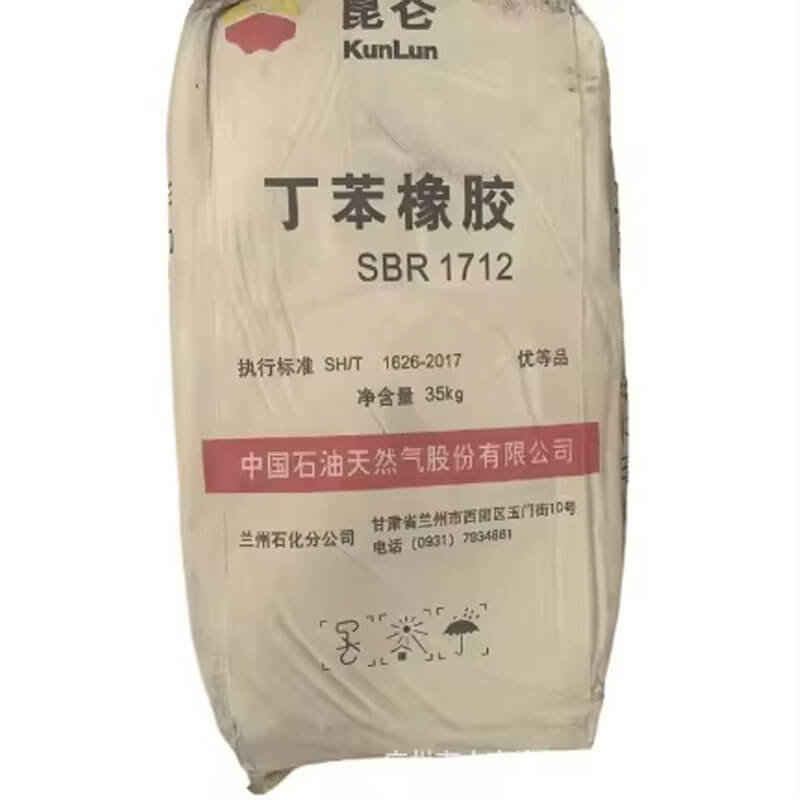
| Product Name | SBR 1712 |
| Polymer Type | Cold emulsion polymerized styrene-butadiene rubber |
| Bound Styrene Percent | 23.5 |
| Oil Extension Phr | 37.5 |
| Oil Type | High aromatic oil |
| Mooney Viscosity Ml1 Plus 4 At 100c | 50 |
| Specific Gravity | 0.94 |
| Volatile Matter Percent | 0.5 |
| Ash Content Percent | 0.3 |
| Organic Acid Percent | 4.5 |
| Soap Content Percent | 0.1 |
| Glass Transition Temperature C | -60 |
| Antioxidant | Staining phenolic |
| Tensile Strength Mpa | 20 |
| Elongation At Break Percent | 500 |
| Modulus 300 Percent Mpa | 7.5 |
As an accredited Styrene‑Butadiene Rubber 1712 factory, we enforce strict quality protocols—every batch undergoes rigorous testing to ensure consistent efficacy and safety standards.
| Packing | Styrene-Butadiene Rubber 1712 is supplied as 25 kg bales, individually wrapped in polyethylene film, stacked on pallets. |
| Container Loading (20′ FCL) | 20′ FCL container loading of Styrene-Butadiene Rubber 1712 in bales, secured properly, protected from moisture and contamination. |
| Shipping | Styrene-Butadiene Rubber 1712 ships as baled polymer wrapped in protective film, loaded on pallets, and packed in dry containers. It is non-hazardous under normal conditions, requiring no specialized tankers. Keep dry, avoid direct sunlight and high heat. Ensure clean, ventilated storage to prevent contamination and maintain product quality during transit. |
| Storage | Store Styrene-Butadiene Rubber 1712 in a cool, dry, well-ventilated area, away from direct sunlight, heat sources, ozone, and strong oxidizers. Keep bales in original sealed packaging to prevent contamination and moisture pickup. Stack neatly on pallets, avoid excessive compression, and follow first-in, first-out stock rotation. Recommended shelf life is typically up to two years. |
| Shelf Life | Store in a cool, dry, dark area, sealed in original packaging; typical shelf life is one year from production date. |
In passenger car radial tread mixing, the oil-extended styrene-butadiene rubber SBR 1712 is handled as a 137.5 phr product weight per 100 phr rubber hydrocarbon because the bale contains 37.5 phr highly aromatic extender oil. A typical tread formulation on total polymer basis uses SBR 1712 at 70–90 phr rubber hydrocarbon and high-cis polybutadiene at 10–30 phr; carbon black N234 or N220 is charged at 65–85 phr, precipitated silica at 10–30 phr, and TESPT coupling agent at 6–8 wt% of silica. Additional petroleum oil is limited to 0–8 phr after accounting for the oil already present in SBR 1712. Zinc oxide is added at 2.5–3.5 phr, stearic acid at 1.5–2.0 phr, 6PPD at 1.5–2.0 phr, antiozonant wax at 0.8–1.2 phr, CBS at 1.2–1.6 phr, DPG at 0.3–0.6 phr when silica is present, and sulfur at 1.4–1.8 phr. The mixing sequence on a 270 L tangential Banbury with fill factor 0.72–0.76 and rotor speed 35–45 min⁻¹ starts with polymer and black, followed by silica and silane, with a ram pressure of 0.4–0.6 MPa and a first-pass dump temperature of 150–160°C to complete silanization without premature sulfur crosslinking. A second non-productive pass at 140–150°C further disperses silica and lowers Mooney viscosity, and the final curatives are added on an open mill at 45–55°C to prevent scorch. Incoming SBR 1712 should be verified for oil content by solvent extraction per ISO 1407:2011, because batch-to-batch variation of ±0.5 wt% in extender oil content can shift compound Mooney viscosity by several units and alter tread extrusion die swell. Extrusion of tread profiles through a pin-barrel extruder with L/D 16:1–20:1 uses barrel temperatures of 65–85°C and screw temperature of 70–90°C, while the tire cure proceeds at 160–170°C for 10–15 min depending tire size and press capacity. Terminal product types are passenger car radial tread strips and light truck tire treads. Compliance for the raw material and compound is anchored to ASTM D412-16 and ISO 37:2017 for tensile properties, ASTM D2240-15 for hardness, ISO 4649:2010 or DIN 53516 for relative abrasion loss, ISO 23529:2016 for specimen preparation, and ASTM D1646-19 for Mooney viscosity and scorch. Legal compliance for EU tire compounds is governed by REACH 1907/2006 Annex XVII Entry 50 paragraph 5, which limits benzo[a]pyrene to 1 mg/kg and the sum of eight listed PAHs to 10 mg/kg in extender oils used for tire production; the classical highly aromatic extender oil in SBR 1712 can exceed these limits, so specification for EU tire production should require a low-PAH DAE oil variant or replace the grade with a TDAE-extended SBR equivalent. The operational boundary for the compounded stock is a storage time of 24–48 h after final mixing at ambient temperatures exceeding 30°C, because the high oil content accelerates physical relaxation and reduces green tack in the building room.
| Standard / regulation | Test method / clause | Application |
|---|---|---|
| REACH 1907/2006 Annex XVII Entry 50 | Paragraph 5 extender oil PAH limits | BaP 1 mg/kg max; sum 8 PAHs 10 mg/kg max in oils for tire production |
| ASTM D412-16 | Tensile stress-strain | Unaged tensile strength and ultimate elongation of vulcanized tread strip |
| ASTM D2240-15 | Durometer hardness | Shore A hardness of tread vulcanizate |
| ISO 4649:2010 | Relative volume loss | DIN abrasion resistance screening of tread compound |
| ISO 23529:2016 | Test specimen preparation | Conditioning and preparation of rubber specimens for physical tests |
Conveyor belt cover compounds for surface mining and quarry duty are formulated with SBR 1712 at 50–80 phr of total polymer and natural rubber at 20–50 phr, with total polymer normalized to 100 phr. Carbon black N220 or N330 is charged at 35–50 phr, precipitated silica at 0–15 phr when improved cutting resistance is specified, additional aromatic oil at 0–10 phr, zinc oxide at 3.0–5.0 phr, stearic acid at 1.5–2.0 phr, 6PPD at 1.0–1.5 phr, antiozonant wax at 0.5–1.0 phr, sulfur at 1.8–2.4 phr, CBS at 0.8–1.2 phr, and a secondary accelerator at 0.1–0.3 phr when required. Mixing in a 100–200 L Banbury at rotor speed 30–40 min⁻¹ uses a first-pass dump temperature of 130–150°C and a final mill temperature below 80°C; the mixed cover stock is then sheeted off a four-roll calender at 65–90°C and laminated directly onto EP fabric carcass plies. Continuous vulcanization in a Rotocure or steel band press is run at 150–170°C for 20–40 min depending cover thickness, with gauge control typically held at ±0.2 mm across a 1200–1600 mm wide line. The terminal product types are general-purpose abrasion-resistant conveyor belts with textile or steel cord carcasses. Compliance standards include ISO 14890:2013 for general-purpose textile-carcass belting, DIN 22102-3 for covers with grades such as DIN Y and DIN X, ISO 4649:2010 for relative volume loss, ISO 283:2015 for full-thickness tensile strength and elongation, and ISO 34-1:2015 for trouser and angle tear specimens. At SBR 1712 additions above 80 phr, tear strength becomes sensitive to carbon black morphology and crosslink density, and tear failure is observed at splice lines and cover lip edges when the compound is over-oiled and under-filled with reinforcing black. The operational boundary for SBR 1712 cover compounds is mineral oil exposure: the grade is not suited to oil-soaked service, and NBR or PVC/NBR covers are required for belt contact with petroleum-based oils. High aromatic oil can also exude to the cover surface if additional oil exceeds 10 phr and cure time is shortened below the recommended cycle.
In compression-molded soling sheet lines that target 75–85 Shore A finished hardness, SBR 1712 is weighed at 100 phr hydrocarbon and blended with precipitated silica at 35–45 phr, TESPT at 2.8–3.6 phr, N330 carbon black at 10–15 phr for color and conductivity, zinc oxide at 3.0 phr, stearic acid at 1.5 phr, sulfur at 1.8–2.2 phr, CBS at 1.0–1.3 phr, and DPG at 0.3–0.5 phr. Mixing is generally two-stage: the first pass in a kneader or Banbury is dumped at 140–150°C to disperse silica and complete silanization, and the second pass on an open mill introduces curatives at 70–80°C. For injection molding, the compound is fed through a reciprocating screw barrel at 65–80°C, and the mold is held at 155–170°C for 3–8 min depending sole thickness; compression molding of pre-cut blanks follows similar cure conditions but uses longer cycles up to 10–12 min for thick heel sections. Terminal products are work-boot soles, direct vulcanized canvas shoe bottoms, and slip-resistant soling sheets. Compliance and performance test methods include ISO 20871:2018 for abrasion resistance of outsoles, ISO 4649:2010 for material relative volume loss, EN ISO 20344:2011 for safety footwear mechanical tests, ASTM D412-16 for tensile properties, and ASTM D2240-15 for hardness. The aromatic extender oil in SBR 1712 can exude to the surface of light-colored soling and cause staining; formulations intended for pigmented translucent or light-tinted soles therefore either use non-staining paraffinic process oils, reduce SBR 1712 content, or apply a lacquered outer coating. The operational limit for direct molded canvas shoes is a compound scorch time sufficiently above the total residence time in the injection unit; at barrel temperatures above 80°C, scorch can occur during interrupted injection cycles.
Industrial rubber sheeting for equipment pads and floor protection is produced from SBR 1712 at 100 phr hydrocarbon with N330 carbon black at 20–30 phr, N774 carbon black at 20–30 phr, kaolin clay at 40–60 phr, calcium carbonate at 20–40 phr, factice at 5–10 phr to reduce calendering shrinkage, zinc oxide at 5.0 phr, stearic acid at 1.5 phr, sulfur at 2.0–2.5 phr, MBTS at 1.0–1.5 phr, and TMTD at 0.2–0.3 phr. Mixing on an open two-roll mill is performed at 45–55°C with a friction ratio of 1:1.2, and the compound is calendered through a three-roll vertical calender at 70–90°C to produce sheet gauges from 2 mm to 10 mm. Curing is carried out in a multi-daylight hydraulic press at 140–150°C for 30–60 min, with the longer cycle required for 10 mm sections to avoid porosity at the center. Terminal products include acid-resistant floor mats, manway gaskets, equipment pads, and tank lining sheet. Compliance for sheet gaskets is anchored to ASTM D1330-04(2015), tensile and elongation to ASTM D412-16, and chemical contact behavior to ASTM D471-16a. The operational boundary for SBR 1712 sheeting is exposure to dilute inorganic acids at ambient temperature; concentrated oxidizing acids, ketones, and aromatic hydrocarbon service causes excessive swell and loss of tensile strength. Published data for specific acid concentration and temperature combinations in SBR 1712 sheeting is limited; each service condition therefore requires immersion testing per ASTM D471-16a before specifying replacement intervals.
In hot-cure retread shops where buffed truck tire casings are wrapped with extruded tread rubber, SBR 1712 is used at 60–80 phr of total polymer and blended with natural rubber at 20–40 phr, with total polymer normalized to 100 phr. The compound contains N220 carbon black at 50–60 phr, additional aromatic oil at 5–10 phr, alkylphenol tackifier resin at 3–5 phr, zinc oxide at 5.0 phr, stearic acid at 1.5–2.0 phr, sulfur at 2.0–2.5 phr, CBS at 0.8–1.2 phr, and DPG at 0.1–0.3 phr when silica is present. Banbury mixing is dumped at 130–150°C; the tread profile is then extruded through a cold-feed pin-barrel extruder at 70–85°C and cut to buffed casing dimensions. The cushion gum layer is calendered to 0.8–1.2 mm and must be used within 24–48 h after calendering because the aromatic oil in SBR 1712 migrates and reduces surface tack over time. Curing of hot-cure retreaded tires proceeds in an autoclave at 120–135°C for 2–4 h, depending tire bead diameter and section width. Terminal product types are retreaded bus and truck tires. Compliance is anchored to UN ECE R108 for retreaded pneumatic tires for motor vehicles and UN ECE R109 for retreaded pneumatic tires for commercial vehicles and trailers; physical property retention is screened using ASTM D412-16 and ASTM D2240-15. The process boundary is a minimum green tack: at relative humidity above 70% or shop temperature below 18°C, the calendered cushion gum must be warmed or treated with fresh tackifier because splice failure occurs during envelope inflation.
Compression-molded automotive trunk and floor mat lines compound SBR 1712 at 100 phr hydrocarbon with 80–100 phr reclaimed rubber, calcium carbonate at 80–120 phr, N550 carbon black at 30–60 phr, additional process oil at 20–30 phr, zinc oxide at 3.0 phr, stearic acid at 1.5 phr, sulfur at 1.5–2.0 phr, CBS at 1.0–1.2 phr, and antidegradant at 1.0–1.5 phr. Mixing is performed in a Banbury at 120–140°C, followed by sheeting on a two-roll mill at 50–70°C; the sheet is cut and compression molded at 150–160°C for 4–8 min. Terminal product types are automotive floor mats, trunk liners, and cab interior mats. Flammability compliance uses FMVSS 302 and ISO 3795:1989 horizontal burn rate, while emissions and odor behavior are screened by VDA 278:2011 for VOC and fog. The operational boundary for SBR 1712 in interior applications is the aromatic extender oil contribution to fogging; low-fogging specifications require replacement with a hydrogenated hydrocarbon oil or TDAE-type extended grade, and the compounder must verify VOC output by thermal desorption before vehicle program approval.
Competitive Styrene‑Butadiene Rubber 1712 prices that fit your budget—flexible terms and customized quotes for every order.
For samples, pricing, or more information, please contact us at +8618136850665 or mail to sales4@ascent-chem.com.
We will respond to you as soon as possible.
Tel: +8618136850665
Email: sales4@ascent-chem.com
Flexible payment, competitive price, premium service - Inquire now!
In cold-polymerized emulsion styrene-butadiene rubber, the industry designation 1712 identifies a copolymer extended with 37.5 phr of highly aromatic extender oil at the latex or finishing stage. The grade belongs to the oil-extended E-SBR class in which the extender oil is not a dry-room process aid but part of the supplied polymer matrix. The rubber hydrocarbon phase contains a bound styrene fraction of 22.5–24.5 wt%, while the as-supplied product contains 26.5–28.5 wt% oil. This corresponds to 27.3 wt% oil on a total-product basis and leaves 72.7 parts of rubber hydrocarbon in 100 parts of sample. Lot-acceptance certificates typically quote Mooney viscosity ML(1+4) at 100 °C between 46 and 56, volatile matter not exceeding 0.75 wt%, ash not exceeding 0.8 wt%, and organic acid between 4.5 and 6.0 wt%. These values are supplier-specific; the exact ratio of rosin acid and fatty acid soap residues can vary between production sites. Procurement should reference the producer’s technical data sheet and standard methods such as ISO 289-1:2018 for Mooney viscosity and ASTM D3185-21 for evaluation of oil-extended SBR. The product should not be confused with dry SBR 1502 or with higher-styrene oil-extended SBR 1721; the grade-specific oil and styrene levels determine both processing behaviour and cured properties.
The most immediate processing consequence of the aromatic extender oil is a reduction in compound viscosity and peak power demand. At equal rubber hydrocarbon content, an oil-extended E-SBR mix typically reaches a stable power plateau earlier than a dry-SBR control because the oil is already distributed through the polymer matrix. In a 160 L intermeshing internal mixer operated at a fill factor of 0.70–0.75, SBR 1712 can be charged as bales or crumb, and carbon black incorporation generally follows the polymer banding stage. Free-oil addition should not be treated as the primary plasticiser because the product already carries 37.5 phr of aromatic oil; adding further oil without adjusting carbon black can create an oil-rich boundary layer on rotor surfaces and reduce batch-to-batch torque repeatability. Dump temperatures are normally held below 160 °C to avoid volatilisation of low-mass aromatic oil fractions and thermal degradation of residual emulsifier. Cure response is similarly tied to the hydrocarbon fraction. A compound that treats 100 parts of SBR 1712 as if it were 100 parts of rubber is underloaded by 27.3 parts of reactive diene material. Sulfur and accelerator additions must be recalculated on the 72.7 parts of rubber hydrocarbon actually present; otherwise the state of cure is reduced and the modulus after accelerated aging may fall below specification. The standard evaluation recipe in ASTM D3185-21 is specifically designed for oil-extended SBR and should be used for lot acceptance instead of an uncontrolled internal recipe.
In high-fill internal mixing, the combination of oil extension and high carbon black loading can produce a narrow processing window. For an intermeshing mixer with a net chamber volume of 160 L, a fill factor of 0.70–0.75 is normally used for tire masterbatches. At fill factors above 0.78, batch temperature can rise faster than rotor-speed calculations predict because the free volume for distributive mixing is reduced and the oil-rich polymer phase may slip at the wall. The result is an apparent reduction in power draw without an equivalent viscosity reduction, followed by oil exudation on the dump table. Published data for SBR 1712 under these exact conditions is limited; however, the behaviour is consistent with the thermal conductivity and phase behaviour of aromatic extender oil in SBR matrices. Rotor speed should be reduced in the final mixing stage rather than relying solely on increased cooling-water flow, because the heat-transfer area is fixed and the oil phase acts as a thermal insulator. This boundary is especially relevant when blending SBR 1712 with natural rubber: the two-phase oil-polymer system can exhibit greater thermocouple lag than dry-SBR blends, and the lag may mask scorch risk in downstream extrusion.
For a two-pass mixing sequence, the first pass may combine SBR 1712 with carbon black, zinc oxide, stearic acid, and an antioxidant after the polymer has banded. The second pass should add sulfur and accelerators below 100 °C to avoid scorch. Because the grade has lower viscosity than dry SBR 1502, it supports higher carbon black loadings in tread formulations, but the loading is limited by the adsorption capacity of the aromatic oil. In passenger-tread compounds, carbon black N330 or N339 is typically used at 50–80 phr on a rubber hydrocarbon basis; published data for SBR 1712 at the upper end of this range is limited, and optimum loading should be established by rheometer and tensile response rather than by mixer cap torque alone. Overloaded mixes can exhibit excessive die swell, rough extrudate surfaces, and uneven filler dispersion, particularly when the second pass is performed on a two-roll mill with a nip gap below 2 mm. Mill temperatures should be controlled near 70 °C; surface oil migration at higher stock temperatures can increase viscosity drift between batches. Antiozonants and antioxidants should be selected for compatibility with the aromatic extender oil because strongly polar additives may have limited solubility in the oil phase and can bloom at the vulcanizate surface.
The comparison with SBR 1502 is dominated by the correction factor of 1.375. SBR 1502 is a dry cold-polymerized styrene-butadiene rubber with a similar bound styrene range but no extender oil. Substituting 100 phr of dry SBR 1502 with 100 phr of SBR 1712 reduces the actual rubber hydrocarbon content from 100 parts to 72.7 parts. The correct mass is 137.5 phr of SBR 1712 per 100 phr of rubber hydrocarbon. The table below summarises the principal grade differences.
| Parameter | SBR 1712 | SBR 1502 |
|---|---|---|
| Bound styrene content | 22.5–24.5 wt% | 22.5–24.5 wt% |
| Extender oil type and loading | Highly aromatic, 37.5 phr | None |
| Mooney viscosity ML(1+4) at 100 °C | 46–56 | 45–55 |
| Rubber hydrocarbon in 100 parts product | 72.7 parts | 100 parts |
| Purchase mass for 100 phr rubber hydrocarbon | 137.5 phr | 100 phr |
Cured properties do not transfer directly between the two grades. At equal rubber hydrocarbon content, the oil-extended vulcanisate generally exhibits lower hardness and lower modulus because the aromatic oil is present as a low-glass-transition phase. Tensile strength and elongation are controlled by carbon black dispersion, crosslink density, and oil content; the oil phase also alters tear resistance and fatigue performance. Dynamic mechanical behaviour is compound-specific, and published data for a universal substitution rule across all tire and non-tire formulations is limited. When reformulating from dry SBR 1502 to SBR 1712, the compounder should retain the rubber hydrocarbon basis and re-derive the curing system from a rheometer study at 160 °C rather than rely on equal-mass substitution.
Extruded tire tread and retread compounds using SBR 1712 are processed on cold-feed pin barrel extruders with L/D ratios of 16 to 20. The oil-extended grade reaches stable die pressure earlier than dry-SBR controls, and the extrudate surface generally shows lower die swell because the aromatic oil reduces elastic recovery. Barrel set temperatures are often reduced by 5–10 °C relative to dry SBR to prevent surface stickiness and premature scorch. On a 90 mm cold-feed pin barrel extruder, a screw speed of 30–40 rpm is representative for medium-hardness tread profiles, but the actual output depends on die geometry and compound viscosity; published data for SBR 1712-specific throughput rates is limited. In mechanical rubber goods, the grade is used in conveyor belts, shoe soling, floor mats, and vibration isolators. Calendering operations generally show lower shrinkage than dry-SBR compounds of equal filler volume. Injection molding is possible with screw plastication systems, but the holding time and melt temperature should be controlled because the aromatic oil lowers heat stability relative to dry SBR. Cure systems for injection molding often use efficient or semi-efficient sulfur-accelerator combinations to balance scorch safety and demolding hardness. Hardness and tensile properties are typically verified by ASTM D412-16 and ASTM D2240-15.
The high aromatic extender oil in SBR 1712 is subject to European Union restrictions under REACH Annex XVII Entry 50. Extender oils used in tire manufacture must not exceed 1 mg/kg benzo(a)pyrene and must not exceed 10 mg/kg for the sum of the eight listed polycyclic aromatic hydrocarbons. This restriction applies to the oil as placed on the market and to tires and tire components; industrial goods for non-tire uses may still fall under the same entry if the oil is present above the threshold. Raw-polymer certificates for SBR 1712 destined for European tire production should include PAH concentration documentation in addition to Mooney viscosity and oil content. Some producers use treated distillate aromatic extract or alternative extender oils that meet the same physical specification but differ in PAH profile. Without supplier documentation, the product should not be assumed compliant. Analytical verification is performed by solvent extraction of the rubber and GC-MS quantification using CEN/ISO methods cited on the supplier certificate.
| Standard or regulation | Parameter or matrix | Limit or test designation |
|---|---|---|
| REACH Annex XVII Entry 50 | BaP in extender oil | 1 mg/kg maximum |
| REACH Annex XVII Entry 50 | Sum of eight PAHs in extender oil | 10 mg/kg maximum |
| ASTM D3185-21 | Oil-extended SBR evaluation | Standard test formulation for SBR mixtures with oil |
| ISO 289-1:2018 | Mooney viscosity ML(1+4) at 100 °C | 46–56 supplier acceptance range |
| ASTM D1646-19 | Mooney viscosity measurement | ML(1+4) 100 °C |
Mooney viscosity specifications are not a substitute for cure testing. A lot with Mooney viscosity at the upper end of 46–56 may still show different vulcanisation kinetics if the extender oil lot varies in aromatic content; therefore lot acceptance should include both viscosity and a standard vulcanizate tensile check. Published data for SBR 1712-specific vulcanisation kinetic parameters is limited because commercial lots differ in emulsifier residues and extender oil aromaticity.
Ambient storage of SBR 1712 in bale or crumb form requires control of heat history, moisture, and light. The product contains 26.5–28.5 wt% oil, so storage above 30–35 °C can promote surface exudation, especially in compressed bales. Moisture uptake at relative humidity above 60% is generally limited to surface condensation on cold material; open crumb can retain water and alter compound viscosity. Ultraviolet exposure should be avoided because surface oxidation of the aromatic oil can cause discolouration and tack changes. Standard dry mixing does not normally require predrying when volatile matter is below 0.75 wt%; however, compounds with long residence time in twin-screw extruders may require hopper drying at 50–60 °C if surface condensation is present. The storage area should be free of strong oxidising agents and solvent vapours because the oil phase can absorb low-boiling organic vapours and alter durometer response. The product is not classified as a highly volatile rubber; however, the aromatic oil may form a thin film on packaging surfaces over time, and this should not be interpreted as polymer degradation alone.